Friday, December 17, 2021

Weird West, or Some Hoot-Hollerin' Hijinks for Weird North

Mood Music

Far from the titanium citadels of the Necrothanes, the unblinking gaze of the Blood Moor obelisks, and the shadow of the dinomancer-ridden Dank Tower, a tumbleweed ambles like an aimless toddler across sun-choked plains of brittle soil. The world has changed so many times, shedding its skin like a desert rattler. What is old is new, what is new is old, and nothing is saved from the long finger of the weird. 
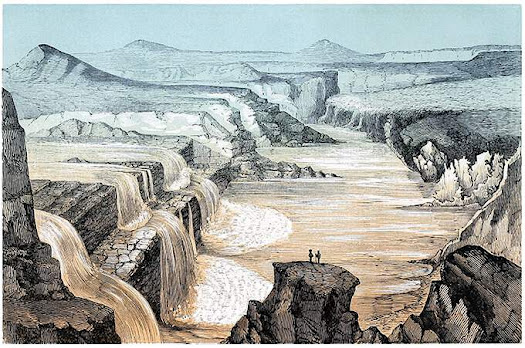
Falls of the Colorado Chiquito

Weird North is a setting. It is a cracked world. An old world. A new world. A place somewhere in the acid fantasy dreams of Jack Vance's cat who had to put up with years of listening to the author prattle on just so. Weird North is a cheater's setting, to be entirely honest. It makes sense in consistent meta terms, at least as far as shared history or global effects and parameters are concerned, but it is still a cheat. A cheat, because frankly neither I nor my players really care that everything must make perfect sense. Perhaps some call this gonzo, perhaps some call this amateur. Perhaps, well, perhaps I don't have much vested interest in what most folks think about my mental gymnastics. The Post/Post/Post Apocalyptic genre is a toolkit and sandbox fit for the kings of recess playgrounds and Saturday morning cartoons. It is, at least, useful for my daydreams.

Thursday, October 28, 2021

Faction Procedures + Dolmenwood Example

Sandboxes tend to imply factions, but faction play is sometimes a boogeyman for open world games. Should it be subtle, just a thought? Should it be a tracked rubric of needs and wants, like a private rumor table with bonuses? Should it be a complex system of rolls and resources, like a solitaire Matrix game the referee plays behind the screen on off-hours? Well, it ought to be something if merely to add some variability to whatever sociopolitical forces prop up the flavor of the setting. 

Monday, October 4, 2021

d66 Star Wars Background Loadouts Adapted from Edge of the Empire

Like I did for Cairn via Old School Essentials, I've adapted here thirty-six backgrounds selected from the greater Edge of the Empire RPG for use in general Star Wars games (specifically, for my purposes, Galaxy Far Away). If using the latter, follow character creation as normal, including random starting items, but also roll d66 (or choose) to determine a background with a unique beginning loadout. The background is a narrative "career" of sorts and should inform gameplay, but its not a shackle and obviously you can go and pew pew (or not) to your choosing. There are no mechanics or modifiers or any such thing tied to the items listed here. It's all keywords and interpretation. Flavor, yo.

Obi-Wan gets it.

Tuesday, August 17, 2021

RPGs with Kids, 6: Prepare for RAMMING SPEED

The game: Any Planet Is Earth

The players: Ted, my kid son (playing Miles, two-term expedtionary). Brian, my older brother (playing Chet Lancaster, three-term expeditionary, two-term mercantile). Nate, my kid nephew (playing Blaze, five-term military). 

The situation: Dornami Station, at the edge of a long trade lane, is evacuating due to a sudden solar shift in the system's star, dooming everyone on board with an imminent supernova.

The complication: The player's are dead-broke and want to hijack the expensive med supplies in the storage complex but are being forced to leave by the private security firm running the station.

The scheme: Leverage guile, lateral thinking, and a bit of gumption to score and leave without a bust (or a blast, ahem).

Ben Nicholas - Artstation

Wednesday, July 14, 2021

Ponderings on Any Planet Is Earth v2

At the time of writing this, I've sold just over 400 copies of Any Planet Is Earth (with about 4,800 downloads). That's small beans, to be sure, in the world of publishing, even in the indie/niche corner of the RPG hobby, but I only ever wanted to release it because it's what I want to run. That said, I am warmed by it's name popping up from time to time on reviews or threads or discussions, and getting messages from strangers and close peers alike who like it a lot and have riffed about with it on their own time. That's neat.

I've had a "second edition" in mind for a while now since it's original release back in June of 2020. My original timeline was a release earlier this year before the arrival of Spring 2021, but then I had another kid and bought a house. There goes 6+ months of so-called free time. C'est la vie.

Jeff Woodman

Friday, April 9, 2021

Twenty Quick Settings/Games for Immediate Use

 About three weeks ago, I posed a simple design challenge to the scene writ large:

  1. Pick a genre, setting, or time period 
  2. Write one or two paragraphs on context 
  3. Produce one page of random tables 
  4. Give advice on tropes and how to use them
Using these guidelines, I surmised that one could create a fully-actionable setting for use at the table, and with the advice and assumptions baked in, little to no abstracted rules would be necessary to actually conduct play. The setting begets the way things work. You agree in good faith to navigate the world as it suggests it can be navigated. Instant sandbox, minimal work. 

Well, I was greeted with TWENTY full responses to this challenge, so without further adieu, enjoy! 

Thursday, April 1, 2021

How I Run and Play an Ultralight Game

I take it for granted that I know how I run and have been running my games for a few years now according to the "free kriegsspiel/FKR" (henceforth "ultralight") approach. For almost a calendar year since this concept has become increasingly vogue across the interwebs, many earnest folks have raised repeat questions not about "what is this?" but "how does it actually work?" At the risk of being overly ironic, think of this post as an introductory rulebook to a style of play that assumes a rulebook is patently unnecessary. I'm going to make this quick, because that's something I especially appreciate about this method: it's fast, it's intuitive, and it only needs a little nudge to get going. 

Disclaimer: This is how I run my games. This is not "how it always works." It is a (hopefully clarifying) example. The approach here is a varied spectrum. Two referees adopting similar styles may yet produce very different tables. This is, of course, how any two different people running any two different games will pan out, but it's worth stating here since there is not, in fact, "one way" to adopt this method. There are various preferences, emphases, and relationships to consider. So, to reiterate, here is how I go about it.